

Introductory lecture course in polyvagal therapy
The science of safety and nervous system regulation — from the authors of the theory, Stephen Porges and Deb Dana. 11 lectures with Ukrainian voice-over that you can take at your own pace.
- 🎧 11 lectures, ≈ 8.5 hours, Ukrainian voice-over
- ♾️ Lifetime access to the recordings
- 🎬 Clinical case study with session videos
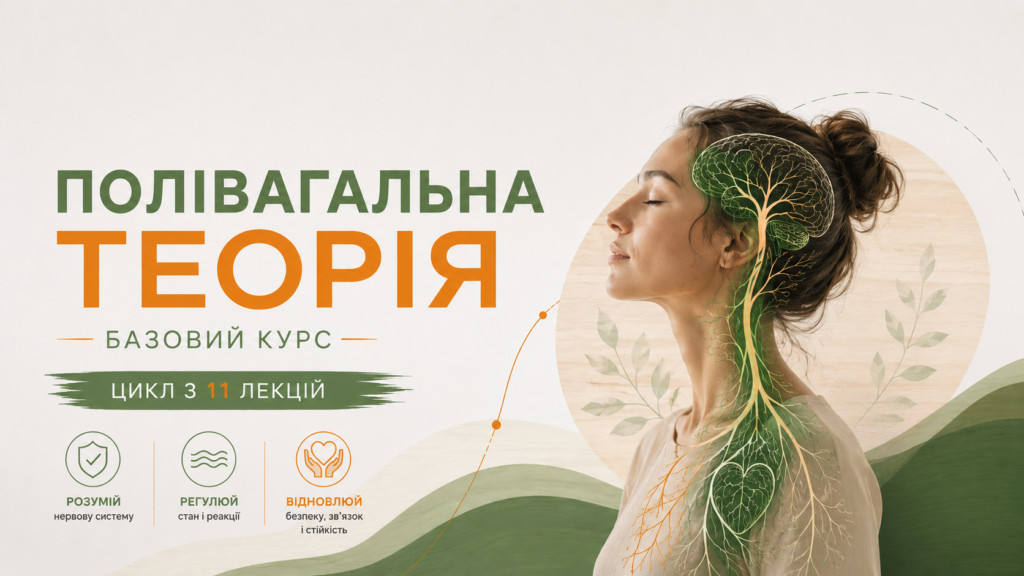
How the nervous system senses safety — and what to do when it loses it
Polyvagal theory explains how the autonomic nervous system constantly scans the environment for cues of safety or threat, and how this shapes behaviour, relationships and health. For a therapist it is a language that helps to see a client's reactions not as resistance but as the body's adaptation.
The course is built on lectures and discussions by Stephen Porges and Deb Dana on the science and clinical application of the theory. It is an introductory level: six sections lead step by step from the evolution of the nervous system to working with trauma, and end with a demonstration clinical case.
Key topics
- Neuroception
- The social engagement system
- The biology of co-regulation
- A unified nervous system
- A new polyvagal vocabulary
- Trauma and autonomic regulation
- The pandemic through a polyvagal lens
- Clinical case

Who will benefit from the course
11 lectures: from evolution to clinical practice
≈ 8.5 hours · at your own pace
The art and science of nervous systems
Social engagement and the “neuroscience of safety”.
Discussion: bringing the science into the session
How an evolutionary perspective changes our understanding of client reactions.
The social engagement system. Interpersonal interaction through regulation of the face and heart muscles
Regulation of the face and heart muscles; the role of the middle ear in hearing the human voice.
Micro-moments of safety and why they matter for effective therapy
How to reduce defensive reactions and create “micro-moments” of safety.
The concept of neuroception
The unconscious sense of safety and threat, and regulation in contact.
The impact of trauma on the autonomic nervous system
How traumatic experience changes the perception of safety and threat.
Trauma: continuing the conversation
Going deeper into trauma and approaches to treatment.
The concept of a unified nervous system model
Integrating the central and visceral systems.
A new vocabulary of polyvagal theory
A body–mind view of mental and somatic disorders.
The COVID-19 pandemic: a polyvagal perspective
Findings based on online survey data.
Polyvagal theory in practice. Videos of a therapist's sessions with a client (demo)
A therapist working with a client and the role of safety in practice.
What you will take away
Learn at a pace that suits you
- Format
- Video recordings, at your own pace
- Length
- 11 lectures · ≈ 8.5 h
- Language
- English with Ukrainian voice-over
- Access
- Lifetime
- Certificate
- Not issued (Polyvagal Institute standard)
The price covers translation, video editing, file storage and KIGiP administrative costs.
Already paid? Log in
Frequently asked questions
Do I need any prior training?
No. This is an introductory course: the material is clear to therapists, students and anyone interested in regulation and trauma.
What language are the lectures in?
The lectures were recorded in English and have a single-voice Ukrainian voice-over.
How long does access last?
Access is unlimited — you can watch the lectures at any time and come back to them.
Is a certificate issued?
No, under Polyvagal Institute standards no certificate is issued for this course.
How do I pay?
Online, by bank card. Terms are set out in the public offer.