




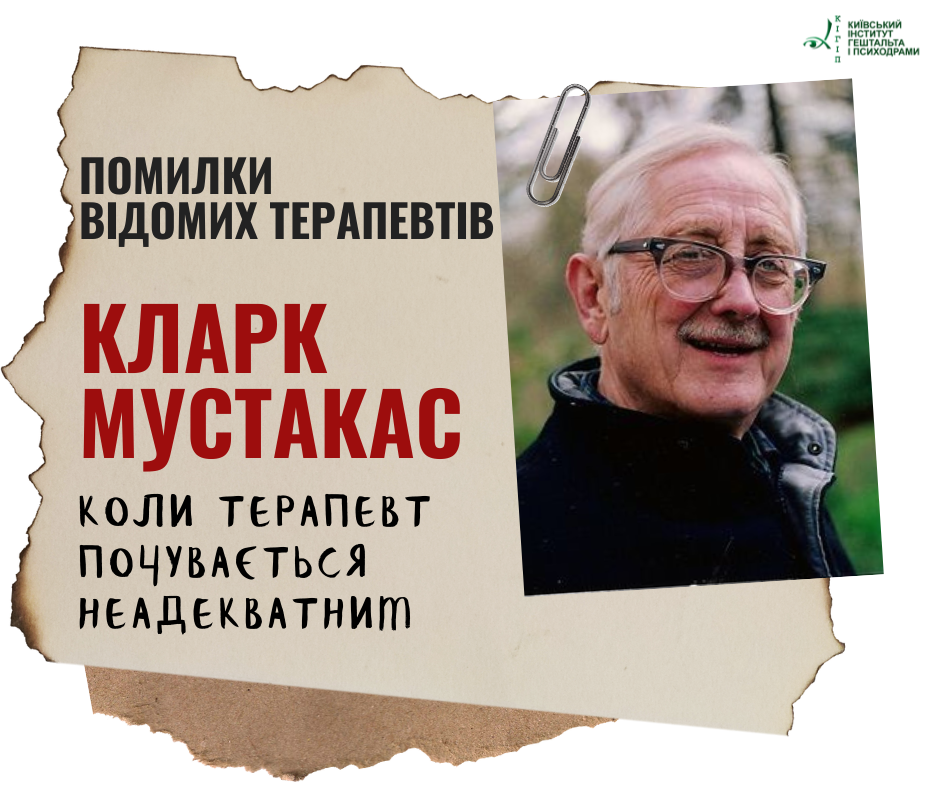
Clark Moustakas was one of the leading proponents of humanistic psychology, the founder of a graduate institute, and the author of numerous books on the subject.
His best-known books include works on loneliness and existential therapy with children.
Let us give him the floor:
At the very beginning of my career as a therapist, I was trained in and practised nondirective therapy.
Soon after completing my training, I worked with a client whose relationships with women were unsuccessful. He wanted advice and recommendations from me on how to solve his problem.
I used the methodology I had been taught effectively: I listened carefully and accurately reflected his thoughts, feelings, and main ideas.
I responded to his statements with understanding and acknowledged his concerns.
In the end, the client criticised me.
He reproached me for merely repeating his words and paraphrasing his thoughts.
I believed I was adding something of my own, but the client did not notice it.
He became angry:
“You aren’t telling me what to do. I need your advice.”
I replied that his need for advice did not fit my way of helping. I believed that if he continued to explore the problem, a solution would emerge.

He said with evident calm:
“You remind me of my former girlfriend. Talking to her was like banging my head against a brick wall!”
The client ended the session, saying it was a waste of time. I never saw him again.
Moustakas did not regard this case as a failure.
He had effectively applied what he had been taught. That model was simply unacceptable to this particular client.
He had not yet begun to question his training and continued to follow what he had been taught. Reflecting on the case, he noted that the experience opened an entirely new area of doubt about his education and allowed him to reconsider his commitment to strictly following the techniques he had learned.
It enabled him to begin experimenting with his own presence as something that facilitates change and growth.

“If I were seeing this client today, I would be more interactive and more confrontational; I still would not give him advice, but I would probably behave more directively, offer more interpretations, and disclose more of myself.
My communication with him was based on an ‘I–It’ relationship.
I am certain that, faced with a similar situation today, I would be more
personally involved and enter into an ‘I–Thou’ relationship.
As you can see, precisely following the dogma of any particular therapeutic approach is no guarantee of success.
To work successfully, a therapist must also develop flexibility, intuition, and creativity.
We invite beginning psychologists and those who already practise but would like to expand their work to join our training and therapy group, “What Kind of Person Are You? What Kind of Psychologist Are You?”.
In this group, we will discuss:
the qualities a psychotherapist needs to develop for effective work,
which field of psychology to choose,
why making a mistake feels so frightening,
which strategies can be used when working with “difficult” clients,
how psychologists can develop their own working style and professional image, and how to present themselves.