




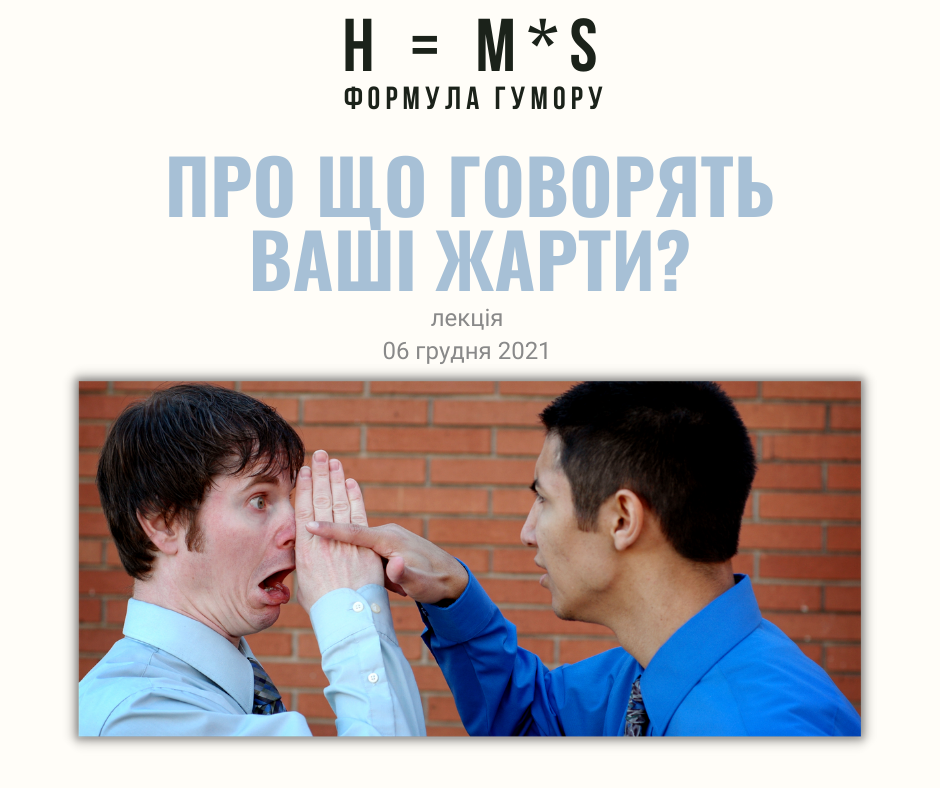
Alastair Clarke, a well-known English scholar in the field of evolution, derived a universal formula of humour.
The formula is fairly simple:
H – the degree of pleasure taken in a good joke (humour)
M – the level of incorrect information contained in the joke (misinformation),
S – the listeners’ capacity to take it seriously (seriousness)

That is, a joke will not work if its author does not distort the facts he is speaking about. This is the basis of humour, and if we speak without «touching up the truth», we will find nothing funny in the story.
Context matters no less.
Is your joke clear to everyone? Is it appropriate? Are the people around you able, in principle, to understand this style of conversation?
The ability to joke is a complex evolutionary mechanism that appeared in humans in the course of their development.
There are studies that have attempted to measure the sense of humour in different people and to link it with other human characteristics.
Which particular «untruth» will we choose as the basis of a joke?
How do we react to other people’s jokes?
What lies behind harmless teasing or behind black humour?

Humour is a far more serious subject than it may seem at first.
And your jokes, and the jokes of the people close to you, are a boundless field for exploration that can tell a great deal about you.
Would you like to find out what is hidden in your jokes, or why you react in a particular way to the jokes of others?
We invite you to a lecture in which we will talk about:
· For what reason do people joke, and what exactly makes them laugh?
· What is a sense of humour and where does it live?
· What kinds of humour are there?
· How is laughter connected with a person’s physical and mental state?
· What feelings and needs do we hide behind our own jokes?
You will have the chance to touch your own sense of humour and to learn a little more about it and about yourself…