




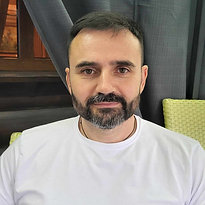
Ruslan Tkachuk
Level 1 gestalt therapy trainer
Professional activity:
Clinical (medical) psychologist.
Certified and accredited gestalt therapist.
Accredited member of the European Association for Gestalt Therapy (EAGT).
Member of the Association of Gestalt Trainers of Ukraine (AGTU).
Trainer at the Kyiv Institute of Gestalt and Psychodrama (KIGiP).
Trainee trainer of level two in gestalt therapy at KIGiP.
Supervisor of study triads.
I provide supervision in the gestalt approach for practising psychologists and gestalt therapists.
I see clients in person in Lviv (for the time being) and online.
Basic higher education:
Ukrainian State Maritime Technical University, mechanical engineer, degree with distinction.
Medical and Natural Sciences University, degree in Psychology, qualification of psychologist, specialisation in medical (clinical) psychology, degree with distinction.
Specialised training:
Moscow Institute of Gestalt and Psychodrama, level two, gestalt therapist. Lead trainer Serhii Sazonov; senior MIGIP trainers Nataliia Turbovets, Olha Aliieva, Mykhailo Kriakhtunov, Heorhii Kushnir, Olha Kardashyna, Maryna Aralova, Tetiana Bielkina, Olena Marynushkina and others, 2011–2015.
Continuing member of the professional supervision group with Jay Levin (GATLA), from 2016 to the present.
Relationships — parent and child, family, between men and women, friendships, work.
Difficulties connected with dependent behaviour, all kinds of non-chemical addiction.
Personal development — lack of confidence, loneliness, low self-esteem, the search for and acceptance of oneself, difficulty with choices.
Psychosomatic symptoms and manifestations.
I work with families, children and adolescents.
Difficult emotional states — fears, anxiety, the aftermath of stress and psychological trauma, PTSD, depression, crises, phobias, obsessive states, panic attacks, chronic fatigue, the «postponed life» syndrome and so on.
Difficulties in the sexual sphere, impotence, infertility.
Eating disorders — bulimia, anorexia, compulsive overeating.
Ruslan about himself:
I first came to psychology in general, and to gestalt therapy in particular, as a client.
Before that I had changed several professions: I was a lab assistant, an engineer, a postgraduate student, an administrator, a salesman; I worked in finance, insurance, trade and business, and managed shops, companies and production sites.
And all that time a very vague idea kept surfacing inside me that something was not right with me.
That I was living somehow wrongly — and that, by and large, I did not know how to live rightly.
I had very poor contact with my own wishes and my emotional life; it was hard for me to make decisions, to choose, or even to notice myself at all.
I was very convenient for those around me and very inconvenient for myself, and I suffered greatly from that.
I was constantly studying, putting on masks, playing roles, forcing myself, trying to become better than others — and losing that race all the time.
My first level in gestalt was full of discoveries about myself and showed me that it could be otherwise.
In the end I took level one several times — three or four, I think — and that became one of the most useful and right decisions of my life. It was a colossal experience as a client.
Then I followed my interest and decided to gain a professional qualification at level two.
I am still amazed by how many implicit, unrecognised processes govern us. And their power lies precisely in that implicitness, that lack of awareness. I very much like noticing implicit processes in myself and in others and making them explicit. That is when a small miracle happens and something changes for the better.
I like going my own way, at my own pace, where and when I want to — and I enjoy my path and my life. I already enjoy it.
My path as a psychologist and gestalt therapist continues.
Now I help other people find themselves, restore their wholeness, learn to notice their wishes and to fulfil them in a way that suits both them and those around them, and to be in harmony with themselves and with the people close to them.
My clients say that this makes them happy. And I believe them.
Perhaps we are going the same way?